
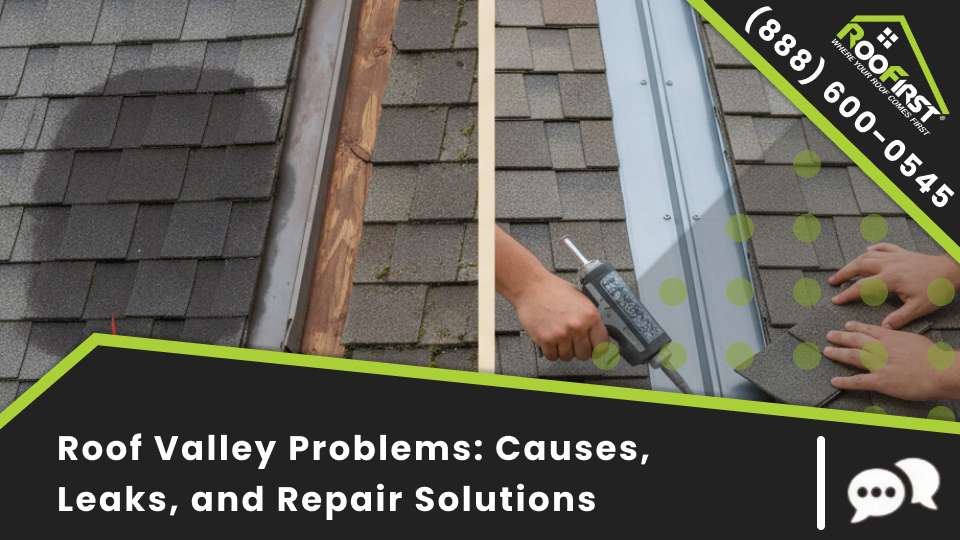
Roof valley problems cause some of the most persistent and damaging leaks homeowners face because valleys channel large volumes of water during every rainstorm. Identifying roof valley issues early prevents water from reaching your decking, insulation, and interior ceilings. A roof valley leak develops when the materials that line the valley deteriorate, shift, or were installed incorrectly. Furthermore, a leaking roof valley sends concentrated water flow directly into your attic and walls rather than off the roof edge. Roof valley repair addresses the failed waterproofing where two roof planes meet and direct water downward. In addition, knowing how to fix a roof valley properly prevents recurring leaks that patching shingles alone cannot solve. Roof valley flashing creates the waterproof channel that directs water safely off the roof.
Likewise, roof valley metal flashing provides the most durable long-term protection for this high-volume water path from a roof valley leak. If you notice water stains on your ceiling below a roof valley, search for roof valley problems near you to get a professional assessment before the damage spreads.
What a Valley Is and Why It Matters
A roof valley is the internal angle where two sloping roof planes meet and direct water downward toward the gutters. Specifically, valleys handle more water volume than any other section of your roof with protection against a roof valley leak.
Here is why roof valleys are critical to your roofing system:
- Every raindrop that lands on either roof plane flows toward the valley
- Valleys concentrate water into a narrow channel that carries enormous flow during storms
- The valley must remain completely watertight because any failure sends water into the structure
- Debris naturally accumulates in valleys creating dams that force water under shingles
- Ice and snow build up in valleys faster than on open roof areas
- Most roof leaks originate at valleys, penetrations, or flashing transitions rather than on open shingle fields
Because valleys handle the highest water concentration on your entire roof, they require the best waterproofing materials and installation quality. Therefore, roof valley problems cause more interior water damage per square foot than almost any other roofing failure.
Types of Roof Valley Construction
Understanding valley construction types helps you identify roof valley issues and discuss repair options with your contractor. Furthermore, each method offers different durability and leak resistance and protection from a roof valley leak.
Open valley with metal flashing Open valleys use roof valley metal flashing visible between the shingles on each side. Furthermore, the metal channel directs water without relying on shingle overlap. In addition, open valleys are the most durable and easiest to maintain because debris clears naturally.
Closed-cut valley Closed-cut valleys extend shingles from one roof plane across the valley while the other side is cut along a chalk line. Consequently, the valley appears covered with shingles. However, the cut edges create a seam where water can penetrate if the shingles lift or curl.
Woven valley Woven valleys alternate shingles from each roof plane across the valley creating an interlocking pattern. Furthermore, this method relies entirely on shingle overlap for waterproofing with no metal flashing beneath. However, woven valleys are more prone to leaking as shingles age and lose flexibility.
Roof valley flashing in an open valley design provides the most reliable long-term waterproofing. Therefore, many roofing professionals recommend converting closed or woven valleys to open metal valleys during roof replacement.
Signs of Roof Valley Problems
Roof valley issues produce specific warning signs that help you identify the problem before extensive damage occurs. Furthermore, catching these signs early saves you from costly interior repairs.
Here are the most common signs of roof valley problems:
- Water stains on the ceiling directly below where two roof planes meet
- Also, shingles in the valley appear lifted, curled, cracked, or missing
- Furthermore, visible rust, holes, or separation in metal valley flashing
- Debris accumulation in the valley that is not cleared by rain
- Additionally, granule loss on shingles in the valley from concentrated water flow
- Ice dam formation along the valley during winter months
- Moss or algae growth concentrated in the valley area
- Finally, daylight visible through the valley when viewed from inside the attic
A roof valley leak often starts as a small stain that homeowners dismiss. Consequently, the stain grows with each rainstorm until water damage reaches the drywall, insulation, and framing beneath the valley.
Common Causes of Roof Valley Problems
Several factors cause roof valley issues to develop over time. Specifically, understanding these causes helps you prevent failures and plan timely repairs.
Deteriorated valley flashing Metal flashing corrodes, develops holes, and separates at seams after years of concentrated water exposure. Furthermore, galvanized steel flashing rusts faster than aluminum or copper in valley applications. In addition, a leaking roof valley frequently traces back to flashing that has reached the end of its lifespan.
Improper installation Valley flashing installed without proper overlap, underlayment, or ice and water shield fails prematurely. Consequently, shortcuts during original construction or previous repairs create leak points that worsen with every storm. Furthermore, flashing that does not extend far enough under the shingles on each side allows water to bypass the channel.
Debris accumulation Leaves, pine needles, branches, and granule buildup create dams in the valley that force water sideways under the shingles. As a result, the valley overflows during heavy rain even when the flashing is intact. In addition, trapped debris holds moisture against the roofing materials accelerating deterioration.
Shingle wear in the valley Valleys experience more wear than open roof areas because of concentrated water flow. Furthermore, the constant water volume strips granules from shingles faster, exposes the asphalt layer, and causes premature cracking. Moreover, worn shingles in a closed or woven valley lose the seal that keeps water out.
Ice dam formation Ice builds up in valleys during winter and forces meltwater under shingles and flashing. Consequently, valleys without ice and water shield membrane beneath the flashing are especially vulnerable to ice dam leaks.
Roof Valley Repair Options
Roof valley repair depends on the type of valley and roof valley issues, the extent of damage, and the age of the surrounding roof. Furthermore, knowing how to fix a roof valley properly requires matching the repair to the specific failure.
Sealant and patching Minor holes or separations in metal flashing can be sealed with roofing cement or flashing sealant. However, this is a temporary fix that buys time before a more permanent repair. Furthermore, patching works best when the surrounding materials are still in good condition.
Valley reflashing Removing the shingles along both sides of the valley and installing new flashing over fresh ice and water shield provides a lasting repair. Specifically, this method addresses flashing failure without requiring a full roof replacement. Furthermore, valley reflashing costs between 500 and 1,500 dollars depending on valley length and roof pitch.
Valley conversion to open metal Converting a failing closed or woven valley to an open metal valley improves water flow and reduces future leak risk. In addition, roof valley metal flashing in an open design allows visual inspection and easier maintenance.
Full valley replacement during reroof When the roof is being replaced, the valley receives new ice and water shield membrane, new flashing, and new shingles. Consequently, this is the most thorough and cost-effective time to address roof valley problems.
When to Call a Professional
Valley repairs involve working on steep angles where water concentration makes footing dangerous. Therefore, contact a professional for roof valley problems near you if any of the following apply:
- Water stains appear on your ceiling below a roof valley after rain
- Valley flashing is visibly rusted, separated, or missing sections
- Shingles in the valley are curling, cracking, or missing
- Debris regularly accumulates in the valley and you cannot safely clear it
- Ice dams form in the valley every winter causing interior leaks
- You want to upgrade from a closed or woven valley to open metal flashing
A roof valley problems expert near you inspects the valley from both the exterior and the attic, identifies every failure point, and recommends the most cost-effective repair. Specifically, they check the flashing condition, underlayment integrity, and shingle wear on both sides of the valley. In addition, they verify the ice and water shield membrane is present and intact beneath the flashing.
Do not let a leaking valley silently destroy your attic and ceilings. Instead, call today to schedule your roof valley inspection and stop water damage before it spreads.
Phone: (888) 600-0545
Email: info@roofirst.com
Website: https://roofirst.com/